Home EV chargers in Poland: power, grid connection and formalities
Updated: 19/11/2026 · 6 min read · Ozeplan editorial team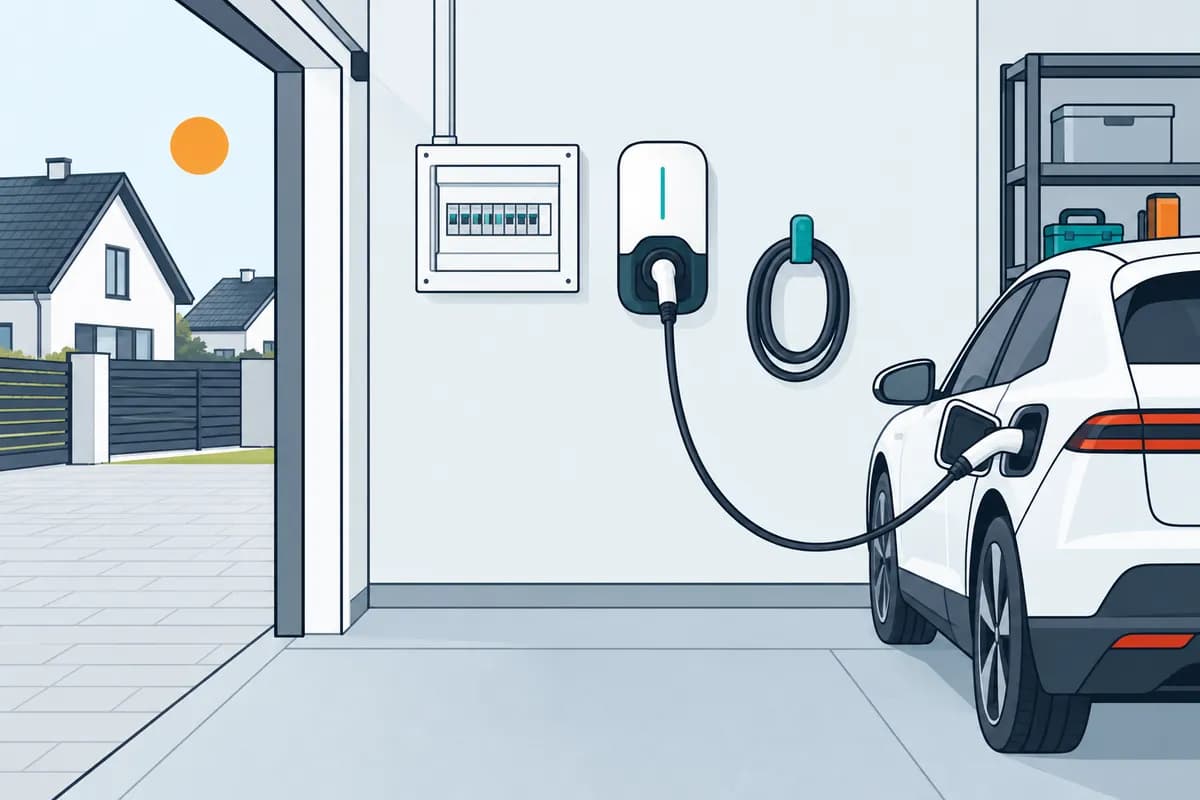
The power of a home charger is limited above all by the building's connection capacity, set in the contract with the distribution system operator. A single-phase charger at 16 A delivers about 3.7 kW, and a three-phase charger at the same current about 11 kW. A charger with load management reduces the charging current when other large appliances are running. Technical inspections by the Office of Technical Inspection (UDT) apply to charging stations as defined in the Polish act on electromobility and alternative fuels; a home charger used only by its owner is, as a rule, not subject to this procedure.
Socket or wall-mounted charger
An electric car can be charged from a household socket with a cable that has a built-in control box (mode 2), or from a charger permanently mounted on a wall or post (mode 3), also called a wallbox.
Charging from a socket is slow and loads the circuit for many hours without a break, so the socket and the circuit must be suitable for it. A wall-mounted charger has its own circuit, controls the charging current and communicates with the car.
Charger power and connection capacity
Approximate charging power at 230 V per phase.
The actual charging power is also limited by the car's on-board charger. If it accepts at most 11 kW of alternating current, a 22 kW wall charger will not shorten charging.
The building's connection capacity follows from the contract with the distribution system operator. An 11 kW charger running for several hours together with an electric cooker, a heat pump or a water heater can exceed it. The solution is load management, which reduces the charging current automatically, or an application to the operator for higher connection capacity.
Installation and protection
The charger has a dedicated circuit with overcurrent protection matched to its current and to the cable cross-section.
Each charging point has its own residual current device and protection against DC fault currents, in line with the PN-HD 60364-7-722 standard.
The installation is carried out by an electrician with a valid qualification certificate, who performs measurements after installation and hands over a test report.
A charger mounted outdoors has an enclosure protection rating suitable for weather conditions, as specified by the manufacturer.
Formalities
Technical inspections by the Office of Technical Inspection (UDT), carried out among others before commissioning, apply to charging stations as defined in the Polish act on electromobility and alternative fuels (Article 16 of the act). A home charger used only by its owner is, as a rule, not subject to this procedure. If the charger is to provide charging to other people or bill a charging service, confirm its status with UDT before commissioning.
In a multi-family building, installing a charger requires agreement with the building manager or the homeowners association.
Charging from solar PV
Charging the car while the solar PV system is producing raises self-consumption, the share of energy used on site. Under net-billing, energy exported to the grid is valued at the market price, which can be low in summer months, so using energy on site brings more benefit than exporting it. Some chargers automatically match the charging current to surplus production.
How exported energy is valued is explained in net-billing, and the value of energy used versus exported in solar PV payback.
Subsidies
The NaszEauto programme, which subsidised the purchase and lease of electric cars by individuals, stopped accepting applications on 30 April 2026. Before buying a charger, check current programmes of your regional environmental fund and municipality, as their offer changes during the year.
Frequently asked questions
What power should a home charger have?
The power is matched to the house's connection capacity, the car's on-board charger and the daily mileage. An 11 kW three-phase charger needs a three-phase supply and spare connection capacity; with a weaker connection, a single-phase charger or load management is used.
Does a home charger need a UDT inspection?
A charger used only by its owner is, as a rule, not subject to UDT inspections, which apply to charging stations as defined in the electromobility act. If charging is to be provided to other people, confirm the status of the device with UDT.
Can I charge the car from a normal socket?
Yes, with a cable that has a control box (mode 2), but charging is slow and the socket and circuit must withstand a load lasting many hours. Before charging this way regularly, have an electrician check the installation.
Is charging from solar PV beneficial?
Yes. Energy used on site replaces energy bought at the full price, while energy exported under net-billing is valued at the market price. Charging during production therefore increases the benefit of the system.
Sources
Regulations and programmes checked on the update date.
See installers who travel to your town: range, availability, projects and checked certificates.
Related guides
This guide is for information only. Regulations and programme terms change, so check the current sources before deciding.